.png)
Why Energy Companies Are Sitting on Millions of Dollars Worth of Unused Operational Data
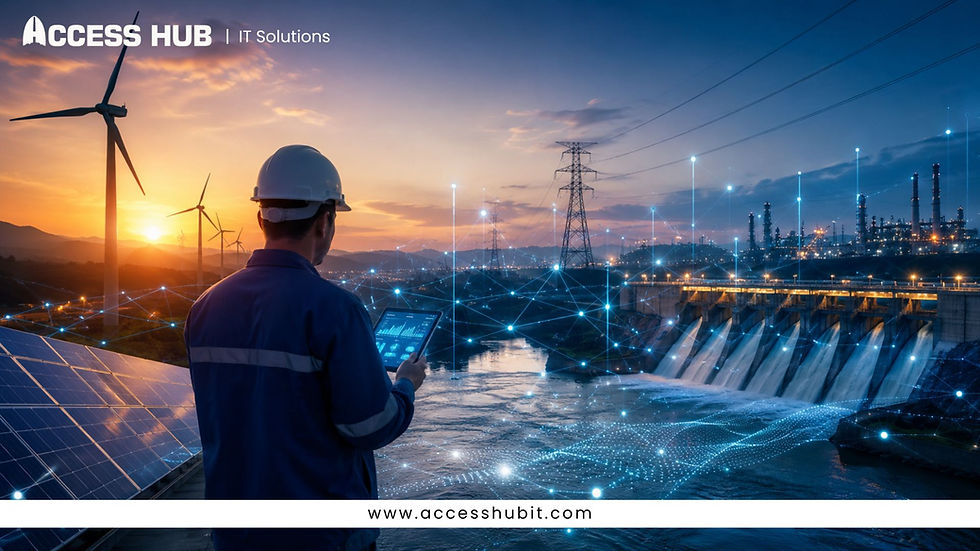
The modern energy industry runs on data.
Every turbine rotation, voltage fluctuation, weather pattern, maintenance alert, fuel reading, and grid anomaly generates information. Utilities and renewable energy operators today collect more operational data than ever before in history.
And yet, most energy companies are barely using it.
Not because the data lacks value, but because it lives in disconnected systems that rarely communicate with one another.
SCADA systems monitor equipment in real time. ERP platforms track financial and operational workflows. Maintenance logs sit inside CMMS tools. Engineers export reports into spreadsheets. Field teams keep manual records. Renewable operators rely on weather APIs and sensor networks. Grid operators juggle infrastructure data across multiple legacy platforms.
The result?
A massive amount of operational intelligence is trapped inside organizational silos.
For many companies, this isn’t just an IT inconvenience. It’s a multimillion-dollar business problem hiding in plain sight.
The Energy Industry’s Biggest Untapped Asset
Most executives in the energy sector think about assets in physical terms, such as substations, turbines, pipelines, transformers, solar farms, batteries, and transmission infrastructure.
But increasingly, the most valuable asset is invisible.
It’s data.
The companies leading the next generation of energy operations are not necessarily the ones building the most infrastructure. They are the ones making smarter decisions faster because their systems are connected.
The uncomfortable reality is that many organizations still operate with fragmented visibility across operations.
An operations manager may not have access to maintenance trends.
A maintenance team may not see procurement delays.
A finance department may not understand asset performance degradation.
A field engineering team may still depend on spreadsheets emailed weekly.
And leadership teams often receive delayed reports instead of real-time operational intelligence.
This fragmentation quietly drains efficiency every single day.
The Hidden Cost of Disconnected Systems
Disconnected operational data creates costs that rarely appear directly on a balance sheet, but they impact profitability everywhere.
According to multiple industry studies, unplanned downtime in energy and utility operations can cost anywhere between $5,000 to over $50,000 per hour, depending on the infrastructure involved. For large-scale generation facilities, even a few hours of downtime can translate into hundreds of thousands of dollars in lost production and operational disruption.
Now multiply that across weeks, months, or years.
A utility company operating multiple substations or renewable assets may unknowingly lose $2–5 million annually due to operational inefficiencies caused by disconnected systems, delayed maintenance insights, poor forecasting, and manual reporting workflows.
And the frustrating part?
Most of these losses are preventable.
For example:
Engineers spending 10 hours weekly manually compiling operational reports can cost companies over $150,000 annually in lost productivity alone.
A wind farm operating even 3% below optimal efficiency could lose hundreds of thousands in unrealized energy generation each year.
Delayed maintenance detection on critical assets can increase repair costs by 30–40% compared to predictive maintenance models.
This is where modern data engineering and AI-driven operational intelligence become transformational rather than optional.
At Access Hub IT Solutions, we help energy companies unify operational data across SCADA systems, ERP platforms, IoT infrastructure, maintenance systems, and business workflows, enabling real-time visibility, predictive analytics, and operational automation.
Data Exists Everywhere, But Intelligence Exists Nowhere
One of the biggest misconceptions in the industry is that companies need more data.
Most don’t.
They already have enormous volumes of operational data.
What they lack is integration.

A utility company may have:
SCADA systems collecting live operational telemetry
ERP systems handling procurement and financial workflows
GIS platforms managing infrastructure mapping
CMMS systems tracking maintenance activity
IoT sensors monitoring equipment health
Spreadsheets maintained by field teams
External weather and environmental datasets
Individually, these systems provide useful information.
Together, they can create operational intelligence powerful enough to transform the business.
But only if the infrastructure exists to unify and analyze that data.
This is where many organizations hit a wall.
Legacy systems were never designed to communicate seamlessly with modern cloud infrastructure, AI models, or real-time analytics platforms. As a result, teams often operate reactively instead of proactively.
The irony is that many energy companies already possess the raw data needed to improve operational efficiency by 15–25%, but they simply cannot access it in a unified, actionable way.
The Shift From Data Collection to Operational Intelligence
The energy companies gaining competitive advantages today are investing heavily in connected data ecosystems.
Instead of isolated systems, they are building centralized data platforms that allow operational, engineering, maintenance, financial, and environmental data to work together in real time.
Once connected, entirely new capabilities emerge.
Predictive maintenance models can identify equipment failures before they occur.
AI systems can optimize energy production based on weather conditions and asset behavior.
Grid operators can improve demand forecasting accuracy.
Executives can access live operational dashboards instead of waiting days for reports.
Field teams can respond faster with accurate, real-time system visibility.
This is no longer futuristic technology.
It is already happening across forward-looking utilities, renewable operators, and infrastructure companies globally.
McKinsey estimates that predictive maintenance powered by AI and connected operational systems can reduce maintenance costs by up to 25% while lowering downtime by as much as 50% in industrial operations.
For a company spending $10 million annually on maintenance and operational disruptions, that could represent $2–3 million in annual savings.
In many cases, the ROI on modern data infrastructure projects can be achieved within 12–18 months.
Why AI Alone Is Not the Answer
There’s enormous excitement around AI in the energy sector right now.
But many organizations make the mistake of trying to implement AI before fixing their data foundations.
AI is only as good as the data feeding it.
If operational data is fragmented, inconsistent, outdated, or inaccessible, AI systems simply amplify inefficiencies instead of solving them.
This is why data engineering matters just as much as AI itself.
Before predictive analytics, automation, or machine learning can deliver value, companies need infrastructure capable of connecting systems, standardizing data, and creating reliable pipelines for analysis.
Without that foundation, even the most advanced AI initiatives struggle to move beyond pilot projects.
The Companies That Move First Will Have the Advantage
The energy transition is accelerating operational complexity across the entire industry.
Renewable integration, grid modernization, decentralized infrastructure, battery storage, electrification, and growing energy demand are forcing companies to operate faster and smarter than ever before.
The organizations that successfully connect their operational data today will have enormous advantages tomorrow.
Not just in efficiency.
But in resilience, scalability, forecasting accuracy, maintenance optimization, regulatory reporting, and long-term profitability.
The truth is, many energy companies are already sitting on millions of dollars worth of untapped operational intelligence.
The challenge is no longer collecting data.
The challenge is finally making it work together.
And the companies that solve this first will not only reduce operational waste, they will build a significant competitive advantage in the next era of energy infrastructure.
If your organization is struggling with disconnected operational systems, delayed reporting, inefficient workflows, or underutilized data, this is the right time to rethink your digital infrastructure strategy.
Explore how Access Hub IT Solutions can help your business build connected, AI-ready operational ecosystems that improve efficiency, reduce downtime, and unlock measurable ROI across energy operations.

Comments